
Friday, November 13, 2026
We came across something today in Filmmaker Magazine's e-newsletter that sent us down a Twitter/X rabbit hole of publicists and journalists arguing about email etiquette.
It started with a tweet from freelance journalist Joshua Hunt:
“To my friends in the PR industry: Please stop following up. There is no need to follow up.”
The post sparked a surprisingly heated debate, with journalists explaining how many unsolicited pitches flood their inboxes every day and publicists defending a practice that has been part of our profession for decades.
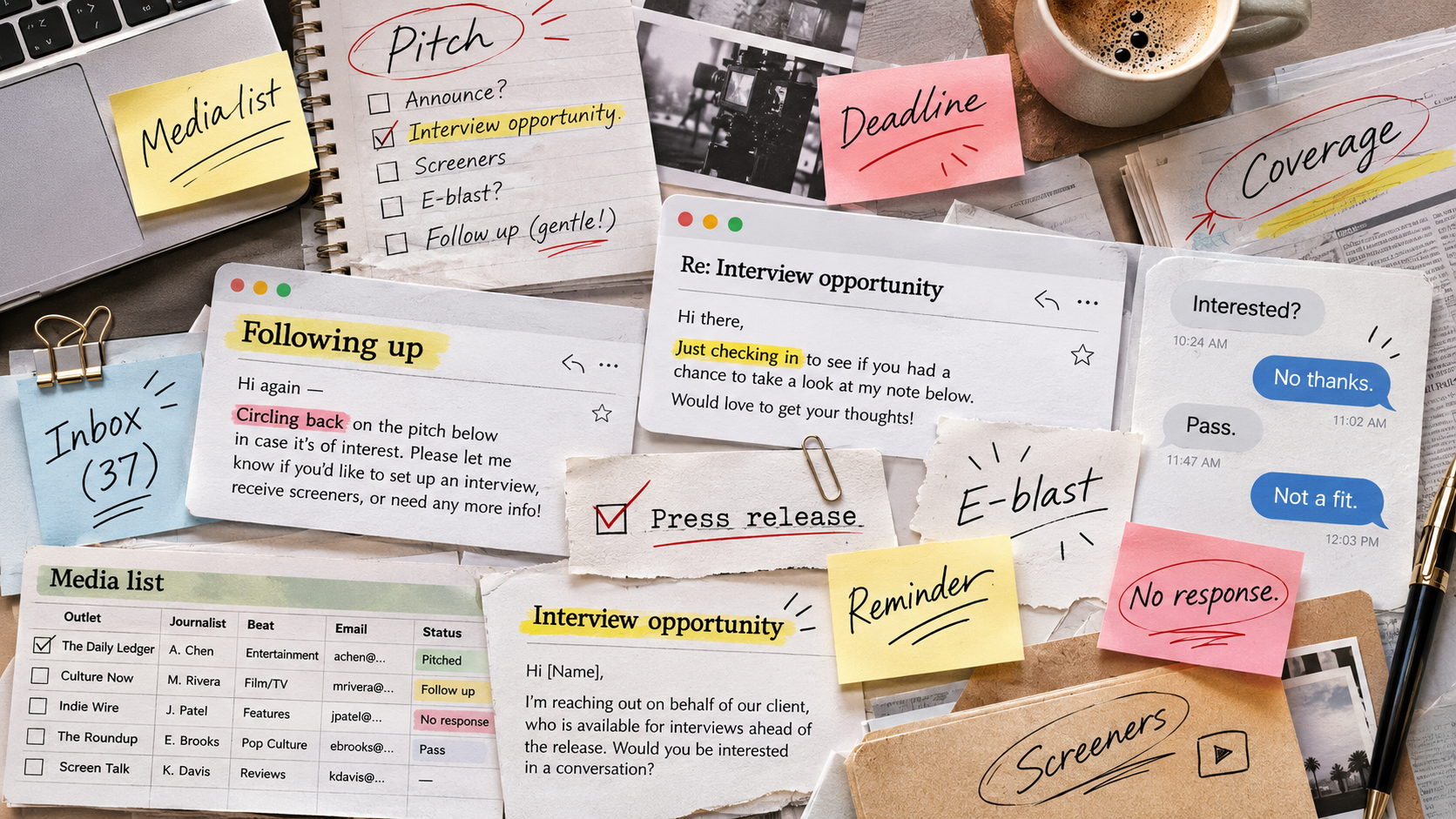
With our agency well established in the entertainment publicity space for many years now, we found ourselves agreeing with points on both sides. But one thing kept bothering most of us: if journalists hate follow-ups so much, wouldn't a simple “no thanks” eliminate a good portion of them?
We understand how that might sound to a journalist staring at hundreds of unread emails. But hear us out.
A “No” Is an Answer
When our founder first started in public relations, he was taught that part of a publicist’s job was to get an answer. Whether that answer was yes or no wasn't necessarily the point. We were expected to establish communication, determine interest, and report back to our clients.
That philosophy has since been introduced to our growing team.
At Millennial PR, when a journalist passes on a film, interview, or story opportunity, that's generally the end of the conversation about that particular pitch. We respect the decision, move on, and usually won't even approach another writer at the same outlet for that story.
A rejection is useful information. It allows us to close the loop, adjust our outreach, and give clients a more accurate picture of where things stand. Complete silence however, leaves us guessing.
Did the journalist see the pitch and decide it wasn't for them? Did it get buried beneath 200 other emails? Was the timing wrong? Did it go to spam? Was the subject line terrible?
Those are very different scenarios, and they don't all warrant the same response from a publicist.
We’re certainly not suggesting journalists should spend their afternoons explaining why a particular project, product, or film isn't right for their publication. A quick “no thanks” is perfectly sufficient. Two words, and we're both free to move on with our lives.
(and for the record, we promise most publicists don't particularly enjoy sending follow-up emails either.)
Let's Talk About Bad Publicists
One of the most common complaints we saw in the discussion was that publicists routinely pitch journalists stories that have absolutely nothing to do with what they cover. That criticism is perfectly fair.
We've all encountered publicists who seem to believe that having someone's email address is sufficient justification to pitch them. Journalists covering politics get beauty products. Film critics get restaurant openings. Business reporters get celebrity skincare launches. Then come three follow-ups asking whether they had a chance to review the information.
That's bad publicity work, and it makes the rest of us look bad.
A publicist should understand who they're pitching, what that person covers, and why the story might genuinely interest them. Following up repeatedly on an irrelevant pitch doesn't demonstrate persistence. It demonstrates that you haven't done your homework.
There's also a distinction between a carefully developed, personalized pitch and a broader email blast that I think gets overlooked in these conversations.
Media databases aren't perfect, and the increasingly widespread use of AI-powered search and categorization has created another layer of complications. (we’re looking at you, Muck Rack….)
A journalist might appear under a broad category such as “women's interests” because they previously wrote about women's rights, female filmmakers, or gender issues in politics. That same category could be used by a publicist building a distribution list for a new organic blush. Obviously…that journalist has no reason to cover a makeup launch.
But we can see how they might inadvertently end up on the distribution list, particularly when a press release spans several different editorial categories.
That doesn't absolve publicists of responsibility. We should be reviewing and refining our media lists, questioning database results, and removing irrelevant contacts whenever possible. AI-generated media targeting still needs human judgment.
It does, however, explain why receiving an irrelevant email doesn't always mean a publicist deliberately ignored a journalist's beat.
Mass distribution and individualized pitching are different approaches to media outreach, and we believe they deserve to be evaluated differently.
Journalists Are Overwhelmed. So Are Publicists.
We don't doubt for a second that many journalists (if not most) receive an overwhelming number of pitches every day. Newsrooms have been shrinking, freelancers are juggling multiple assignments, and the sheer volume of unsolicited email has made inbox management a job in itself.
We can acknowledge expecting a personalized response to every unsolicited pitch is unrealistic, while still believing there's room for better communication.
Publicists are also managing multiple clients, deadlines, campaigns, and sometimes hundreds of individual media conversations. We're responsible for presenting viable opportunities to journalists and keeping our clients informed about the progress of their campaigns.
When a client asks whether a particular publication is interested, there's a meaningful difference between telling them the outlet declined and explaining that we've received no response.
And while good publicists understand that no amount of pitching guarantees coverage, we still have a responsibility to pursue opportunities and make reasonable efforts to establish contact.
That's part of why follow-ups happen.
There's also an irony here that we don't think should be overlooked: plenty of freelance journalists regularly pitch editors themselves. They understand the frustration of putting together a thoughtful proposal, sending it to the appropriate person, and hearing absolutely nothing back.
Of course, an editor receiving a freelance pitch and a journalist receiving an unsolicited PR email aren't identical situations. But both involve someone trying to communicate a potentially relevant opportunity to a busy person.
Sometimes the Follow-Up Actually Works
Here's another issue with the blanket advice to stop following up: sometimes journalists genuinely miss emails.
Many of us have had pitches receive interest only after a follow-up. We've also had journalists acknowledge that an earlier message got buried. Neither situation is particularly unusual in a profession conducted almost entirely through email.
And sometimes a story becomes more relevant a week later! (a film receives a release date, an interview opportunity opens up, or a journalist's editorial calendar changes, etc.)
A thoughtful follow-up can provide useful information, particularly when there's a legitimate development or time-sensitive opportunity.
But, of course, there should be limits.
If a journalist has explicitly requested no follow-ups, respect that preference. If someone has declined, don't keep pushing. If you've already followed up and received nothing, eventually it's time to move on.
And if you're sending the same “just floating this to the top of your inbox” message every three days, you probably need to reconsider your approach…
But declaring that publicists should never follow up seems unnecessarily rigid, especially when every journalist has different preferences and every story has different circumstances.
A Little Professional Courtesy Goes Both Ways
We of course do not believe journalists owe publicists coverage, interviews, or even an explanation for why they're passing on something. Editorial independence matters. A journalist's responsibility is to their readers and the stories they believe are worth telling.
But - professional courtesy matters too.
When someone has taken the time to research your work, develop a relevant angle, and send a thoughtful pitch, we don't think it's unreasonable to hope for a brief acknowledgment when you have the capacity to respond.
Even a rejection. (…especially a rejection.)
If you're a journalist who receives hundreds of pitches every day, we understand that responding to every single one is impossible. Prioritize the ones that are genuinely relevant, the publicists you've established relationships with, or the opportunities that warrant a clear decision.
If you have a strict no-follow-up policy, make that preference known. If you only respond to pitches you're interested in, communicate that somewhere publicists can reasonably find it.
And on the PR side, publicists need to do a better job of respecting those preferences, researching our contacts, managing our distribution lists, and recognizing when silence should be the end of a particular outreach effort.
We also think it's worth remembering that publicists and journalists often depend on one another professionally. Publicists help facilitate access to filmmakers, talent, screeners, and information. Journalists bring independent judgment, reporting, and critical perspective to the stories they choose to pursue.
The relationship works best when there's mutual respect for what each side is trying to accomplish; a journalist shouldn’t feel obligated to respond to every email; a publicist shouldn’t be made to feel unprofessional for sending one or two reasonable follow-ups.
Final Thoughts
We're not immune to making mistakes, either. With thousands of media contacts across different campaigns, even well-maintained lists aren't always accurate. Journalists change beats, move between outlets, and increasingly work across traditional and digital media. We periodically reach out to contacts to confirm their coverage interests, pitching preferences, which email is correct to use, etc.. Sometimes those conversations help us make meaningful improvements. Other times, we hear nothing.
And those mistakes matter. A journalist who becomes frustrated enough to stop opening our emails isn't just a missed opportunity for one campaign. That relationship could be valuable to another client years down the road. We have every reason to get this right, even if we won't always get it right.
Which brings us back to the original debate. We still believe a simple “no thanks” can prevent unnecessary follow-ups, and we understand why journalists don't always have the time or inclination to send one. But we’re more interested in finding ways to improve the process than arguing over who should be doing more.
We'd genuinely like to hear how others are approaching this. What could publicists do differently to make outreach more useful and less intrusive? What would make it easier for journalists to communicate their preferences? Are there practices or systems already working that more of us should adopt?
And perhaps most importantly, is there a reasonable middle ground between expecting a response to every pitch and assuming that silence should always be the end of the conversation?
We welcome the discourse.
